
8-Puzzle Solver → Route Finding in Robotics
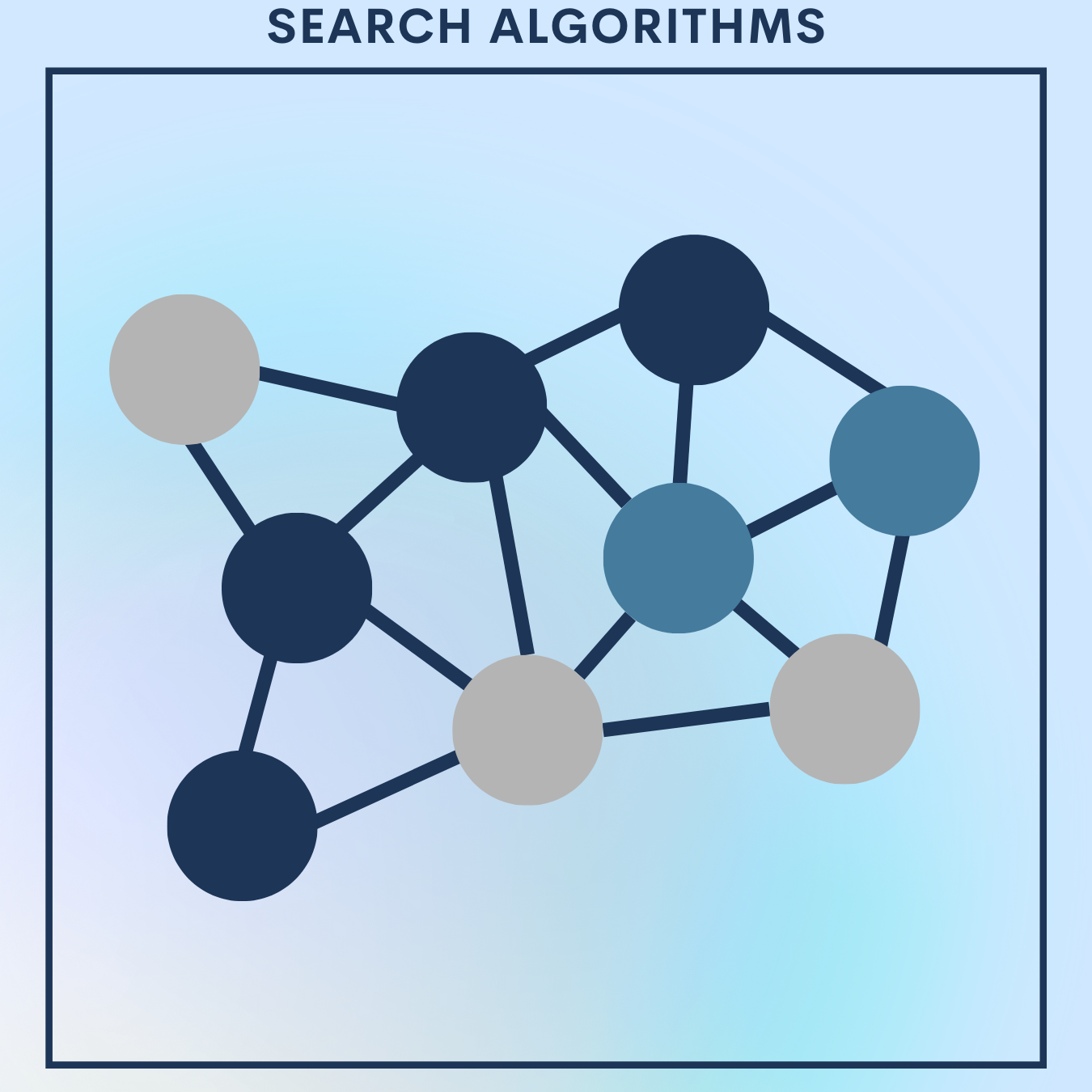
Why Search Algorithms?
Breadth-First Search (BFS) and Depth-First Search (DFS) are the bedrock of problem solving in AI. They teach you how to systematically explore a state space (all possible configurations of a problem) and recover a solution path. You’ll use the exact same ideas later for heuristic search (A*), constraint solvers, planning, and even within modern robotics stacks for pathfinding on occupancy grids.
What you’ll build today: (a) an 8-puzzle solver using BFS/DFS; (b) a grid route-finding demo, the building block for robotics navigation.
Search Algorithms
1. State spaces, nodes, and operators
A state describes a configuration (e.g., a 3×3 board permutation in the 8-puzzle, or a robot’s $(x,y)$ cell on a grid).
Operators (actions) move you from one state to another (swap the blank tile up/down/left/right; move the robot to a neighboring free cell).
A path is a sequence of actions from start to goal.
2. Search tree vs. graph search
Tree search: expands states without remembering visited ones; risks exponential revisitation.
Graph search: maintains a visited/explored set to avoid cycles and repeated work. Almost always preferred for finite spaces.
3. Breadth-First Search (BFS)
Explores the shallowest nodes first using a FIFO queue.
On unweighted graphs (every step costs the same), BFS is complete and optimal—it finds the shortest path in number of steps.
Time complexity: 


Space complexity: also
When to use: shortest path on unweighted graphs/grids; small to moderate depth problems.
4. Depth-First Search (DFS)
Explores along a path as deep as possible using a stack (or recursion), then backtracks.
Time complexity: 


Completeness: not guaranteed in infinite-depth spaces (can get stuck going deep).
Optimality: not optimal (may return a longer path than necessary).
When to use: memory-constrained settings; when any solution suffices and deep solutions are likely.
5. Practical variants you’ll meet soon
Iterative Deepening DFS (IDDFS): combines low memory usage of DFS with completeness/optimality (in unit cost settings) by deepening the limit:

Bidirectional search: search forward from start and backward from goal; often reduces complexity from 
Heuristic search (A):* prioritizes nodes using 

6. 8-puzzle specifics (for today’s toy problem)
There are 

A configuration is solvable iff its inversion count parity matches the goal’s. An inversion is a pair of tiles 


BFS is great for finding the shortest move sequence; DFS can quickly find a sequence (not necessarily shortest).
Toy Problem – 8-Puzzle Solver (BFS & DFS)
We’ll represent the 3×3 board as a length-9 tuple with 0 as the blank:
Dataset Snapshot (Representation)
Goal:          Example start (solvable):
(1,2,3,        (1,2,3,
 4,5,6,         4,5,6,
 7,8,0)         0,7,8)
Actions: move the blank 0 up/down/left/right when legal.
State space: neighbors are states produced by swapping 0 with an adjacent tile.
1 – Utilities: neighbors, solvability, and path reconstruction
Step 1: Imports and goal definition
Use Python’s deque for queues later; define the canonical goal state for the 8-puzzle.
from collections import deque

# 8-puzzle goal configuration: 0 denotes the blank tile.
GOAL = (1, 2, 3,
        4, 5, 6,
        7, 8, 0)
Step 2: Index helpers (flat index ↔ row/col)
These tiny helpers convert between the flat 0–8 index and (row, col) in a 3×3 grid—handy for legal-move checks.
def index_to_rc(i):
    """Map flat index [0..8] -> (row, col) in a 3x3 grid."""
    return divmod(i, 3)

def rc_to_index(r, c):
    """Map (row, col) -> flat index [0..8] in a 3x3 grid."""
    return r * 3 + c
Step 3: Neighbor generator (legal moves)
Given a state (a tuple of 9 ints with 0 as blank), yield next states by sliding the blank up/down/left/right when possible—each with its action label.
def neighbors(state):
    """
    Generate (next_state, action) for all legal blank moves.
    action in {"Up","Down","Left","Right"} describes the blank's motion.
    """
    i0 = state.index(0)          # blank position
    r, c = index_to_rc(i0)
    moves = []
    for dr, dc, action in [(-1, 0, "Up"), (1, 0, "Down"),
                           (0, -1, "Left"), (0, 1, "Right")]:
        nr, nc = r + dr, c + dc
        if 0 <= nr < 3 and 0 <= nc < 3:
            j = rc_to_index(nr, nc)           # tile to swap with blank
            new_state = list(state)
            new_state[i0], new_state[j] = new_state[j], new_state[i0]
            moves.append((tuple(new_state), action))
    return moves
4. Path reconstruction (states + actions)
After search fills parent and action maps, rebuild the full sequence of states and the aligned action list from start→goal.
def reconstruct_path(parent, action, goal_state):
    """
    Reconstruct (path_states, path_actions) from parent/action maps.
    - parent[s] = predecessor state or None for the start
    - action[s] = action taken to reach s from parent[s] (None for start)
    """
    # Rebuild states
    path_states = []
    s = goal_state
    while s is not None:
        path_states.append(s)
        s = parent[s]
    path_states.reverse()

    # Rebuild actions (aligned with transitions path_states[0]->...->path_states[-1])
    path_actions = []
    s = goal_state
    while s is not None and action[s] is not None:
        path_actions.append(action[s])
        s = parent[s]
    path_actions.reverse()

    return path_states, path_actions
5. Inversion count (parity test ingredient)
Count out-of-order tile pairs ignoring the blank; used to determine solvability parity for the 8-puzzle.
def inversion_count(state):
    """
    Count inversions: pairs (i,j) with i<j but state[i] > state[j], ignoring 0.
    """
    arr = [x for x in state if x != 0]
    inv = 0
    for i in range(len(arr)):
        for j in range(i + 1, len(arr)):
            if arr[i] > arr[j]:
                inv += 1
    return inv
6. Solvability check (8-puzzle)
A start state is solvable iff its inversion parity matches the goal’s inversion parity (for 3×3 with blank allowed anywhere).
def is_solvable(state, goal=GOAL):
    """
    8-puzzle solvable iff inversion parity matches the goal's parity.
    """
    return inversion_count(state) % 2 == inversion_count(goal) % 2
2 – Breadth-First Search (BFS)
1. Function signature & early exits
Check for trivial success and solvability before doing any work.
def bfs(start, goal=GOAL):
    """
    Breadth-First Search on the 8-puzzle state space.
    Returns (path_states, path_actions) for a shortest solution (unit-cost),
    or None if unsolvable or not found.
    """
    if start == goal:
        return [start], []
    if not is_solvable(start, goal):
        return None
2. Frontier (queue) and bookkeeping
Use a FIFO queue; track parents and actions for reconstruction; keep a visited set to avoid repeats.
    from collections import deque

    q = deque([start])   # FIFO frontier
    parent = {start: None}
    action = {start: None}
    visited = {start}
3. Main BFS loop (level-order expansion)
Pop from the left, expand neighbors, and enqueue unseen states.
    while q:
        s = q.popleft()
        for ns, a in neighbors(s):
            if ns not in visited:
                visited.add(ns)
                parent[ns] = s
                action[ns] = a
4. Goal test and path reconstruction
As soon as we discover the goal, rebuild and return the shortest path.
                if ns == goal:
                    return reconstruct_path(parent, action, ns)
                q.append(ns)
5. No solution found (shouldn’t happen for solvable states)
Return None if the queue empties without success.
return None
3 – Depth-First Search with Depth Limit (DFS-limited)
3.1. Function signature & early exits
Same quick checks; a depth limit prevents infinite descent.
def dfs_limited(start, goal=GOAL, max_depth=30):
    """
    Depth-First Search with a depth bound.
    Returns (path_states, path_actions) if a solution is found within max_depth,
    else None. Not guaranteed shortest, but uses low memory.
    """
    if start == goal:
        return [start], []
    if not is_solvable(start, goal):
        return None
3.2. Frontier (stack) and lightweight memory
Use an explicit stack to avoid recursion depth issues. Track the best-known depth per state to allow beneficial revisits.
    stack = [(start, 0)]     # (state, depth)
    parent = {start: None}
    action = {start: None}
    visited_depth = {start: 0}  # state -> shallowest depth discovered
3.3. Main DFS loop (deepening within limit)
Pop from the stack (LIFO), check goal, then push neighbors if within the depth cap.
    while stack:
        s, d = stack.pop()
        if s == goal:
            return reconstruct_path(parent, action, s)
        if d < max_depth:
            # reversed neighbor order to mimic recursive DFS (optional)
            for ns, a in reversed(neighbors(s)):
                nd = d + 1
3.4. Prune worse revisits; record parents/actions; push deeper
Only proceed if we’ve never seen ns or we’ve found a shallower route to it.
                if ns not in visited_depth or nd < visited_depth[ns]:
                    visited_depth[ns] = nd
                    parent[ns] = s
                    action[ns] = a
                    stack.append((ns, nd))
3.5. No solution within the depth limit
If the stack empties, either no solution exists within max_depth or the instance is very deep.
return None
4 – Run the Demo
What this does: solves a simple starting position with both BFS and limited DFS and prints the move count with action sequence.
if __name__ == "__main__":
    start = (1,2,3,4,5,6,0,7,8)  # easy solvable example

    out_bfs = bfs(start)
    if out_bfs is not None:
        states, actions = out_bfs
        print(f"BFS: moves={len(actions)}, actions={actions}")
    else:
        print("BFS: Unsolvable or not found.")

    out_dfs = dfs_limited(start, max_depth=30)
    if out_dfs is not None:
        states, actions = out_dfs
        print(f"DFS (limited): moves={len(actions)}, actions={actions}")
    else:
        print("DFS: Not found within depth.")
Quick Reference: Full 8-puzzle Code
from collections import deque

GOAL = (1,2,3,4,5,6,7,8,0)

def index_to_rc(i): return divmod(i, 3)
def rc_to_index(r, c): return r*3 + c

def neighbors(state):
    i0 = state.index(0)
    r, c = index_to_rc(i0)
    moves = []
    for dr, dc, action in [(-1,0,"Up"), (1,0,"Down"), (0,-1,"Left"), (0,1,"Right")]:
        nr, nc = r+dr, c+dc
        if 0 <= nr < 3 and 0 <= nc < 3:
            j = rc_to_index(nr, nc)
            new_state = list(state)
            new_state[i0], new_state[j] = new_state[j], new_state[i0]
            moves.append((tuple(new_state), action))
    return moves

def reconstruct_path(parent, action, goal_state):
    path_states, path_actions = [], []
    s = goal_state
    while s is not None:
        path_states.append(s)
        s = parent[s]
    path_states.reverse()
    s = goal_state
    while s is not None and action[s] is not None:
        path_actions.append(action[s])
        s = parent[s]
    path_actions.reverse()
    return path_states, path_actions

def inversion_count(state):
    arr = [x for x in state if x != 0]
    inv = 0
    for i in range(len(arr)):
        for j in range(i+1, len(arr)):
            if arr[i] > arr[j]: inv += 1
    return inv

def is_solvable(state, goal=GOAL):
    return inversion_count(state) % 2 == inversion_count(goal) % 2

def bfs(start, goal=GOAL):
    if start == goal: return [start], []
    if not is_solvable(start, goal): return None
    q = deque([start])
    parent = {start: None}
    action = {start: None}
    visited = {start}
    while q:
        s = q.popleft()
        for ns, a in neighbors(s):
            if ns not in visited:
                visited.add(ns)
                parent[ns] = s
                action[ns] = a
                if ns == goal:
                    return reconstruct_path(parent, action, ns)
                q.append(ns)
    return None

def dfs_limited(start, goal=GOAL, max_depth=30):
    if start == goal: return [start], []
    if not is_solvable(start, goal): return None
    stack = [(start, 0)]
    parent = {start: None}
    action = {start: None}
    visited_depth = {start: 0}
    while stack:
        s, d = stack.pop()
        if s == goal: return reconstruct_path(parent, action, s)
        if d < max_depth:
            for ns, a in reversed(neighbors(s)):
                nd = d+1
                if ns not in visited_depth or nd < visited_depth[ns]:
                    visited_depth[ns] = nd
                    parent[ns] = s
                    action[ns] = a
                    stack.append((ns, nd))
    return None
Real‑World Application — Route Finding in Robotics (Grid BFS/DFS)
We’ll model a robot moving on a 2D occupancy grid. Each free cell has unit cost; obstacles are blocked.
- BFS → shortest number of steps from start to goal (in 4-connected grids).
- DFS → any reachable path (not necessarily shortest); small memory footprint.
Step 1: Grid representation & neighbors
What this does: encodes a small map with obstacles and defines legal 4-connected moves.
from collections import deque

FREE, BLOCK = 0, 1

grid = [
    [0,0,0,0,0,0,0,1,0,0],
    [0,1,1,1,0,0,0,1,0,0],
    [0,0,0,1,0,1,0,0,0,0],
    [0,1,0,0,0,1,0,1,1,0],
    [0,1,0,1,0,0,0,0,1,0],
    [0,0,0,1,0,1,1,0,0,0],
    [1,1,0,0,0,0,0,1,0,0],
    [0,0,0,1,1,0,0,0,0,0],
]

start = (0, 0)  # (row, col)
goal  = (7, 9)

def in_bounds(r, c):
    return 0 <= r < len(grid) and 0 <= c < len(grid[0])

def grid_neighbors(r, c):
    for dr, dc, action in [(-1,0,"Up"), (1,0,"Down"), (0,-1,"Left"), (0,1,"Right")]:
        nr, nc = r+dr, c+dc
        if in_bounds(nr, nc) and grid[nr][nc] == FREE:
            yield (nr, nc), action
Step 2: BFS for shortest path
What this does: uses a queue to expand cells by distance and reconstructs the shortest path when the goal is reached.
def bfs_grid(start, goal):
    if start == goal:
        return [start], []
    q = deque([start])
    parent = {start: None}
    action = {start: None}
    visited = {start}
    while q:
        r, c = q.popleft()
        for (nr, nc), a in grid_neighbors(r, c):
            nxt = (nr, nc)
            if nxt not in visited:
                visited.add(nxt)
                parent[nxt] = (r, c)
                action[nxt] = a
                if nxt == goal:
                    # reconstruct
                    path, acts = [], []
                    s = nxt
                    while s is not None:
                        path.append(s)
                        s = parent[s]
                    path.reverse()
                    s = nxt
                    while s is not None and action[s] is not None:
                        acts.append(action[s])
                        s = parent[s]
                    acts.reverse()
                    return path, acts
                q.append(nxt)
    return None
Step 3: DFS (any path)
What this does: explores deeply first with a depth cap; returns any discovered route.
def dfs_grid(start, goal, max_depth=512):
    stack = [(start, 0)]
    parent = {start: None}
    action = {start: None}
    visited_depth = {start: 0}
    while stack:
        (r, c), d = stack.pop()
        if (r, c) == goal:
            # reconstruct
            path, acts = [], []
            s = (r, c)
            while s is not None:
                path.append(s)
                s = parent[s]
            path.reverse()
            s = (r, c)
            while s is not None and action[s] is not None:
                acts.append(action[s])
                s = parent[s]
            acts.reverse()
            return path, acts
        if d < max_depth:
            for (nr, nc), a in reversed(list(grid_neighbors(r, c))):
                nd = d + 1
                if (nr, nc) not in visited_depth or nd < visited_depth[(nr, nc)]:
                    visited_depth[(nr, nc)] = nd
                    parent[(nr, nc)] = (r, c)
                    action[(nr, nc)] = a
                    stack.append(((nr, nc), nd))
    return None
Step 4: Run the robotics demo
What this does: finds a shortest route (BFS), prints the steps and a simple ASCII map; also attempts a DFS path.
def render_path_on_grid(path):
    g = [row[:] for row in grid]
    for r, c in path:
        if (r, c) not in (start, goal):
            g[r][c] = 2  # mark path
    # Simple ASCII renderer
    legend = {0:'.', 1:'#', 2:'*'}
    for r in range(len(g)):
        line = ''.join(legend[x] for x in g[r])
        print(line)

if __name__ == "__main__":
    out = bfs_grid(start, goal)
    if out:
        path, acts = out
        print(f"BFS shortest length = {len(path)-1}, actions = {acts}")
        render_path_on_grid(path)
    else:
        print("No BFS path found.")

    out2 = dfs_grid(start, goal, max_depth=1024)
    if out2:
        path, acts = out2
        print(f"DFS path length = {len(path)-1}, actions = {acts}")
    else:
        print("No DFS path found.")
Quick Reference: Full Grid Pathfinding Code
from collections import deque

FREE, BLOCK = 0, 1
grid = [
    [0,0,0,0,0,0,0,1,0,0],
    [0,1,1,1,0,0,0,1,0,0],
    [0,0,0,1,0,1,0,0,0,0],
    [0,1,0,0,0,1,0,1,1,0],
    [0,1,0,1,0,0,0,0,1,0],
    [0,0,0,1,0,1,1,0,0,0],
    [1,1,0,0,0,0,0,1,0,0],
    [0,0,0,1,1,0,0,0,0,0],
]
start, goal = (0,0), (7,9)

def in_bounds(r, c): return 0 <= r < len(grid) and 0 <= c < len(grid[0])
def grid_neighbors(r, c):
    for dr, dc, a in [(-1,0,"Up"), (1,0,"Down"), (0,-1,"Left"), (0,1,"Right")]:
        nr, nc = r+dr, c+dc
        if in_bounds(nr, nc) and grid[nr][nc] == FREE:
            yield (nr, nc), a

def bfs_grid(start, goal):
    if start == goal: return [start], []
    q = deque([start])
    parent = {start: None}
    action = {start: None}
    visited = {start}
    while q:
        r, c = q.popleft()
        for (nr, nc), a in grid_neighbors(r, c):
            nxt = (nr, nc)
            if nxt not in visited:
                visited.add(nxt)
                parent[nxt] = (r, c)
                action[nxt] = a
                if nxt == goal:
                    path, acts = [], []
                    s = nxt
                    while s is not None:
                        path.append(s)
                        s = parent[s]
                    path.reverse()
                    s = nxt
                    while s is not None and action[s] is not None:
                        acts.append(action[s])
                        s = parent[s]
                    acts.reverse()
                    return path, acts
                q.append(nxt)
    return None

def dfs_grid(start, goal, max_depth=512):
    stack = [(start, 0)]
    parent = {start: None}
    action = {start: None}
    visited_depth = {start: 0}
    while stack:
        (r, c), d = stack.pop()
        if (r, c) == goal:
            path, acts = [], []
            s = (r, c)
            while s is not None:
                path.append(s)
                s = parent[s]
            path.reverse()
            s = (r, c)
            while s is not None and action[s] is not None:
                acts.append(action[s])
                s = parent[s]
            acts.reverse()
            return path, acts
        if d < max_depth:
            for (nr, nc), a in reversed(list(grid_neighbors(r, c))):
                nd = d+1
                if (nr, nc) not in visited_depth or nd < visited_depth[(nr, nc)]:
                    visited_depth[(nr, nc)] = nd
                    parent[(nr, nc)] = (r, c)
                    action[(nr, nc)] = a
                    stack.append(((nr, nc), nd))
    return None

def render_path_on_grid(path):
    g = [row[:] for row in grid]
    for r, c in path:
        if (r, c) not in (start, goal):
            g[r][c] = 2
    legend = {0:'.', 1:'#', 2:'*'}
    for r in range(len(g)):
        print(''.join(legend[x] for x in g[r]))

if __name__ == "__main__":
    out = bfs_grid(start, goal)
    if out:
        path, acts = out
        print(f"BFS shortest length = {len(path)-1}, actions = {acts}")
        render_path_on_grid(path)
    else:
        print("No BFS path found.")
    out2 = dfs_grid(start, goal, max_depth=1024)
    if out2:
        path, acts = out2
        print(f"DFS path length = {len(path)-1}, actions = {acts}")
Strengths & Limitations
Strengths
- BFS: complete and optimal on unit-cost graphs; simple to implement; ideal for shortest paths on grids.
- DFS: tiny memory footprint; returns a path quickly if deep solutions exist; easy to implement recursively or iteratively.
- Both: foundational—build intuition for advanced methods (IDDFS, A*, D*, RRT, etc.).
Limitations
- BFS: memory-hungry (
- DFS: not optimal; can fail to terminate in infinite or cyclic spaces without careful handling (limits/visited).
- Both (uninformed): ignore problem-specific guidance; scale poorly versus informed (heuristic) search.
Final Notes
You learned how to model problems as search over states, apply BFS to guarantee shortest paths on unit-cost spaces, and use DFS to find any feasible route with minimal memory. You implemented both an 8-puzzle solver and a robotics-style grid pathfinder.
These patterns directly transfer to more advanced planning and navigation algorithms and prepare you to add heuristics (A*), dynamic replanning (D*), or sampling-based planners—core tools in modern AI and robotics.
Next Steps for You:
Add heuristics: implement A* for the 8-puzzle using 

Scale the environment: switch the grid to an image-based occupancy map (e.g., PNG → grid), then compare BFS vs. A* with a Euclidean/Manhattan heuristic.
(Optional) Try IDDFS and bidirectional BFS on the 8-puzzle and measure empirical speedups.
References
[1] S. J. Russell and P. Norvig, Artificial Intelligence: A Modern Approach, 4th ed. Hoboken, NJ, USA: Pearson, 2020.
[2] R. E. Korf, “Depth-first iterative-deepening: An optimal admissible tree search,” Artificial Intelligence, vol. 27, no. 1, pp. 97–109, 1985.
[3] P. E. Hart, N. J. Nilsson, and B. Raphael, “A formal basis for the heuristic determination of minimum cost paths,” IEEE Transactions on Systems Science and Cybernetics, vol. 4, no. 2, pp. 100–107, 1968.
[4] J. Pearl, Heuristics: Intelligent Search Strategies for Computer Problem Solving. Boston, MA, USA: Addison-Wesley, 1984.
[5] R. E. Korf, “Finding optimal solutions to Rubik’s Cube using pattern databases,” AAAI, pp. 700–705, 1997; and related work on the 15/24-puzzle.
[6] S. M. LaValle, Planning Algorithms. Cambridge, U.K.: Cambridge Univ. Press, 2006.
[7] T. H. Cormen, C. E. Leiserson, R. L. Rivest, and C. Stein, Introduction to Algorithms, 3rd ed. Cambridge, MA, USA: MIT Press, 2009.
 Applied AI Tutorials
Leave a comment