
House Price Prediction → Sales Forecasting
Why Linear Regression?
Imagine you’re a real estate agent trying to estimate house prices. You know that bigger houses usually cost more, but you want a systematic way to predict prices for new properties.
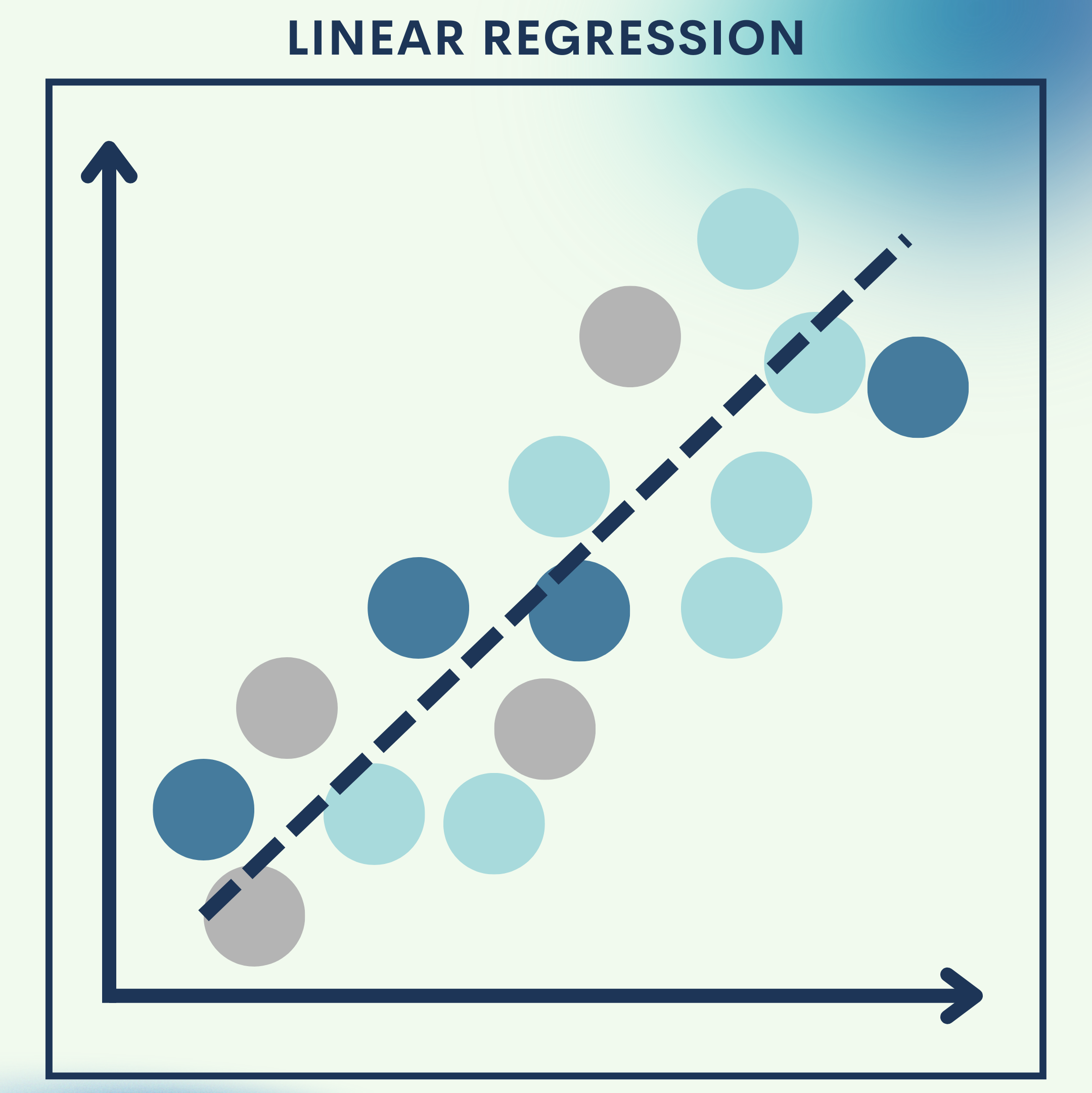
This is where Linear Regression comes in. It finds the best straight-line relationship between inputs (like house size) and outputs (like price).
In real-world business, the same principle scales up: companies use Linear Regression to forecast sales, predict demand, and understand customer trends.
How Linear Regression Works
Linear Regression is one of the oldest and most widely used algorithms in statistics and machine learning. Its main purpose is to model the relationship between one or more input variables (features) and an output variable (target).
The idea is simple: if we suspect that the output 

Simple Linear Regression
In the simplest case, we try to model the relationship between one input variable 

Where:
: the intercept — the baseline value of
.
: the slope — how much $latexY $ increases when
: the error term, capturing noise and factors not explained by
Example: If 


Multiple Linear Regression
In real-world problems, one variable is rarely enough to explain the outcome. For example, house prices may depend on size, number of bedrooms, and location. To handle this, we use multiple input features:

Where:
are the input features (e.g., house size, number of bedrooms, distance to city).
are the coefficients (weights) showing the influence of each feature.
is still the intercept, and
remains the error term.
Each coefficient 


Objective: Finding the Best Line (Training the Model)
How do we know which line (or hyperplane) fits the data best?
The most common method is Ordinary Least Squares (OLS). The idea is to choose the coefficients 


Where:
: number of training samples.
: the cost function we want to minimize.
Minimizing this function ensures that the regression line is as close as possible to all the data points.
Geometric Intuition
- In simple regression, we are fitting a straight line in 2D space.
- In multiple regression, we are fitting a flat plane (hyperplane) in higher dimensions.
The regression line is chosen such that the sum of squared vertical distances between the actual points and the line is minimized.
Why Linear Regression Works Well
- Interpretability – Each coefficient tells us how much a feature contributes to the outcome.
- Efficiency – It can be solved directly using matrix algebra (closed-form solution), so training is very fast.
- Baseline performance – Even in complex AI projects, Linear Regression is often the first model tested because it provides a clear baseline.
Toy Problem – House Price Prediction
We’ll use a simplified dataset of houses where the size of the house (sq. ft.) predicts the price.
Dataset Snapshot
| Size (sq. ft.) | Price (in $1000s) |
|---|---|
| 850 | 150 |
| 900 | 170 |
| 1200 | 220 |
| 1500 | 260 |
| 1800 | 300 |
Step 1: Import Libraries
We load essential libraries for data handling, visualization, and regression modeling.
import numpy as np
import pandas as pd
import matplotlib.pyplot as plt
from sklearn.linear_model import LinearRegression
Step 2: Prepare Dataset
We structure our data into features (house size) and target (price).
# Create dataset
data = {'Size': [850, 900, 1200, 1500, 1800],
        'Price': [150, 170, 220, 260, 300]}
df = pd.DataFrame(data)

X = df[['Size']]  # feature
y = df['Price']   # target
Step 3: Train Model
We fit a Linear Regression model on the dataset.
model = LinearRegression()
model.fit(X, y)
Step 4: Make Predictions
We generate predicted prices for the given house sizes.
predictions = model.predict(X)
print(predictions)
Step 5: Visualize Results
We plot the actual data points and the regression line.
plt.scatter(X, y, color='blue', label='Actual')
plt.plot(X, predictions, color='red', linewidth=2, label='Predicted')
plt.xlabel("House Size (sq. ft.)")
plt.ylabel("Price ($1000s)")
plt.legend()
plt.show()
Quick Reference: Full Housing Price Toy Problem Code
import numpy as np
import pandas as pd
import matplotlib.pyplot as plt
from sklearn.linear_model import LinearRegression

# Dataset
data = {'Size': [850, 900, 1200, 1500, 1800],
        'Price': [150, 170, 220, 260, 300]}
df = pd.DataFrame(data)

X = df[['Size']]
y = df['Price']

# Train model
model = LinearRegression()
model.fit(X, y)

# Predictions
predictions = model.predict(X)

# Plot
plt.scatter(X, y, color='blue', label='Actual')
plt.plot(X, predictions, color='red', linewidth=2, label='Predicted')
plt.xlabel("House Size (sq. ft.)")
plt.ylabel("Price ($1000s)")
plt.legend()
plt.show()
Real‑World Application — Sales Forecasting
Retailers often want to forecast future sales based on advertising budget (TV, Radio, Online). Linear Regression can quantify how each channel contributes to sales and predict total revenue.
Step 1: Load Advertising Dataset
We define features (ad spend) and target (sales).
import pandas as pd
from sklearn.model_selection import train_test_split

# Sample advertising dataset
data = {'TV': [230, 44, 17, 151, 180],
        'Radio': [37, 39, 45, 41, 10],
        'Online': [69, 45, 69, 58, 20],
        'Sales': [22, 10, 9, 18, 15]}

df = pd.DataFrame(data)
X = df[['TV', 'Radio', 'Online']]
y = df['Sales']
Step 2: Train/Test Split
We split data into training and testing sets for evaluation.
X_train, X_test, y_train, y_test = train_test_split(X, y, test_size=0.2, random_state=42)
Step 3: Train Model
We fit Linear Regression using ad spend to predict sales.
model = LinearRegression()
model.fit(X_train, y_train)
Step 4: Evaluate Model
We evaluate how well the model predicts sales.
from sklearn.metrics import mean_squared_error, r2_score

y_pred = model.predict(X_test)
print("MSE:", mean_squared_error(y_test, y_pred))
print("R²:", r2_score(y_test, y_pred))
Full Code Collection: Full Real-World Application Code
import pandas as pd
from sklearn.model_selection import train_test_split
from sklearn.linear_model import LinearRegression
from sklearn.metrics import mean_squared_error, r2_score

# Dataset
data = {'TV': [230, 44, 17, 151, 180],
        'Radio': [37, 39, 45, 41, 10],
        'Online': [69, 45, 69, 58, 20],
        'Sales': [22, 10, 9, 18, 15]}
df = pd.DataFrame(data)

X = df[['TV', 'Radio', 'Online']]
y = df['Sales']

# Train/test split
X_train, X_test, y_train, y_test = train_test_split(X, y, test_size=0.2, random_state=42)

# Train model
model = LinearRegression()
model.fit(X_train, y_train)

# Evaluate
y_pred = model.predict(X_test)
print("MSE:", mean_squared_error(y_test, y_pred))
print("R²:", r2_score(y_test, y_pred))
Strengths & Limitations
Strengths
- Simple and easy to interpret.
- Fast to train, even on large datasets.
- Useful as a baseline model.
Limitations
- Assumes linear relationships (not always realistic).
- Sensitive to outliers.
- Cannot capture complex interactions between features.
Final Notes
In this tutorial, we learned:
- The theory of Linear Regression and how it models relationships.
- How to apply it to a toy problem (house price prediction).
- How businesses use it in real-world scenarios (sales forecasting).
Linear Regression is not just academic — it’s one of the most applied AI techniques in business and research.
Next Steps for You:
Explore Polynomial Regression to model nonlinear trends.
Try applying regression to time series forecasting (e.g., monthly sales data).
References
[1] I. Goodfellow, Y. Bengio, and A. Courville, Deep Learning, MIT Press, 2016.
[2] T. Hastie, R. Tibshirani, and J. Friedman, The Elements of Statistical Learning, Springer, 2009.
[3] Scikit-learn Documentation: https://scikit-learn.org/stable/modules/linear_model.html
 Applied AI Tutorials
Leave a comment